hot take: fat girls are allowed to have standards. fat girls are allowed to think you’re ugly and gross and unattractive and that you’re not worth their time. they shouldn’t have to settle because you already have dehumanized them and determined they are worth less than you. why would any woman want to be with a person who thinks she doesn’t respect herself because of the shape of her body? fat women are not easy, we’re not freaks who will do whatever you want to feel approval. we’re not desperate. We have no reason to be grateful for you.
“Don’t call Trump supporters nazis, it hurts their feelings.”
Yes, this is real (link to tweet). Yes, Tucker Carlson is literally repeating Nazi propaganda that aided the genocide of the Romani during the Holocaust. Yes, I am furious.
(Also, although there is a large population of Romani in Romania, they aren’t indigenous to Romania. They’re a diasporic group originally from northern India.)
Romani and Jewish have been screaming at the top of their lungs for years about neo-fascism in Europe, and Americans were totally aloof.
Then neo-fascism reared its head in America, but Roma and Jews were left out of the conversation in terms of people being impacted, because our oppression was “over.”
Now Tucker Carlson is on live TV using slurs and Nazi propaganda about Romani people, and I’m 90% most people on the left are just going to ignore it.
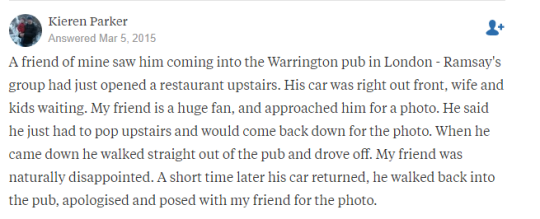
He comes from a very poor family. His father was an alcoholic who beat him and his mother (he once poured hot tea over her and put her in hospital several times), his brother is a drug addict, he literally built an empire out of nothing.
He credits his mother as his biggest inspiration and often has her cooking in his shows.
When he left his first restaurant he pulled a successful Jerry Maguire
– the entire kitchen staff went with him. That tells you what he’s like to work with.
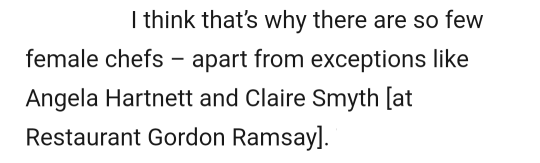
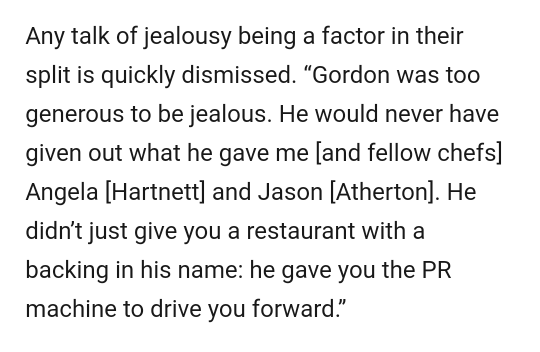
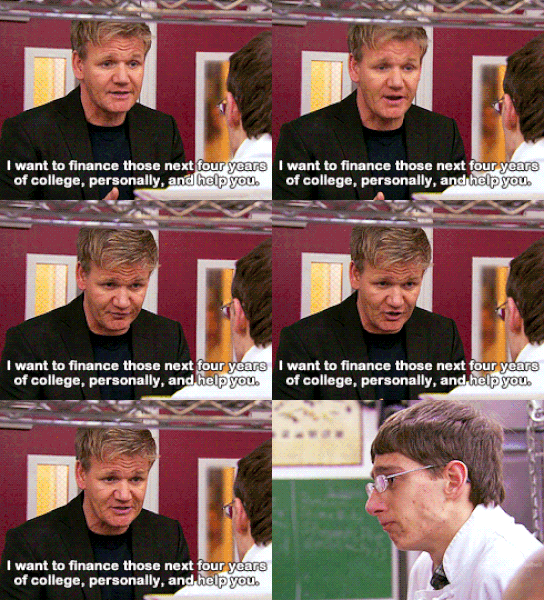
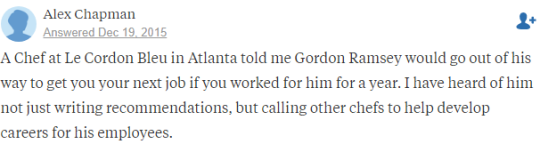
He was one of the first to give a restaurant to a female chef.
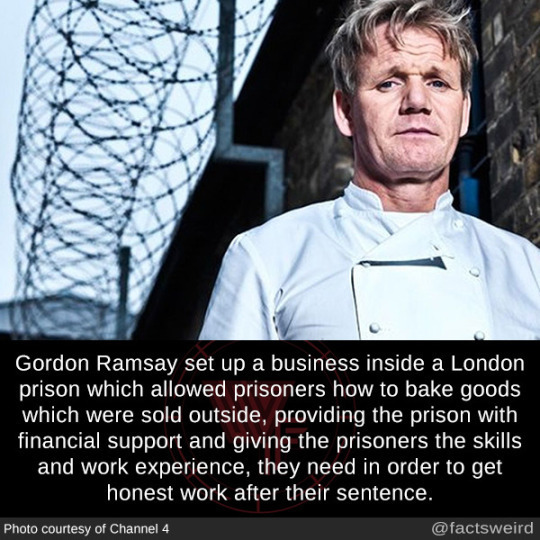
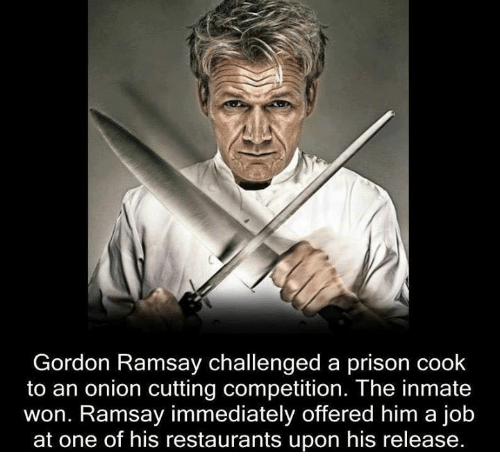
He went to prison (Gordon Behind Bars) and taught inmates to bake and they opened a bakery (Bad Boys Bakery) that is still running. He hired one of them when he got out.
He did documentaries about the cruelty of shark hunting and cocaine. (when he discovered cocaine was used by his staff he didn’t fire anyone but made sure they are offered treatment)
His kids are a treasure.
He is always ALWAYS kind to servers.
When one of his partners (Marcus Wareing) wanted to leave they got into a fight and settled it in court, they no longer speak to each other but this is what Marcus said about him after the fight:
I feel bad that the first association to him for a lot of people is this shouty TV chef when he’s truly a wonderful person.
never forget that the reason he’s “shouty and angry” on his tv show is that he’s yelling at people who ignore the rules of courtesy and food safety and basically feed their customers poison, something which would enrage any good person
Uncle Gordon
Gordon is precious and I love him.
I’m really glad people post stuff like this because honestly yes, the only thing I knew about Gordon Ramsey at first was that he swears like a sailor. It’s good to know that he’s a much more genuine person than that. This is probably also a good example of how television can shape our perceptions of people; TV producers are going to focus on what gets the most attention, not on what is necessarily best or most true about a person. It’s good to be mindful of that while watching reality shows and movies.
The HR manager tried to convince me that the offer was competitive. She told me that she couldn’t offer more because it would be unfair to
other paralegals. She said that if we did not agree to a salary that
day, then she would have to suspend me because I would be working past
the allowed temp phase. I insisted that she look into a higher offer and
she agreed that we could meet again later. Before I left, she had
something to add.
“Make sure you don’t talk about your salary with anyone,” she said
sweetly, as if she was giving advice to her own son. “It causes conflict
and people can be let go for doing it.” (This is to the best of my
recollection, not verbatim.)
It wasn’t all that surprising to hear this from a corporate HR manager. What was surprising was the déjà vu.
Just three months earlier, some of my coworkers at the coffee shop
told me that our bosses, who worked in the office on salaries, and even
the owner, got a higher cut of the tips than we did. One barista told me
that when she complained about it, the managers reduced her hours.
When you make minimum wage and have to fight for more than 30 hours
per week, tips are pretty important, so I sat down with my managers to
discuss the controversy. That’s when they told me not to talk about it
with the other baristas. The owner “hates it when people talk about
money,” my manager added, and “would fire people for it if he could.” I
sulked back to the espresso machine, making my lattes at half speed and
failing to do side work.
In both workplaces, my bosses were breaking the law.
Under the National Labor Relations Act of 1935 (NLRA), all workers
have the right to engage “concerted activity for mutual aid or
protection” and “organize a union to negotiate with [their] employer
concerning [their] wages, hours, and other terms and conditions of
employment.” In six states, including my home state of Illinois, the law even more explicitly protects the rights of workers to discuss their pay.
This is true whether the employers make their threats verbally or on
paper and whether the consequences are firing or merely some sort of
cold shoulder from management. My managers at the coffee
shop seemed to understand that they weren’t allowed to fire me solely
for talking about pay, but they may not have known that it is also
illegal to discourage employees from discussing their pay with each
other. As NYU law professor Cynthia Estlund explained to NPR,
the law “means that you and your co-workers get to talk together about
things that matter to you at work.” Even “a nudge from the boss saying
‘we don’t do that around here’ … is also unlawful under the National
Labor Relations Act,” Estlund added.
And yet, gag rules thrive in workplaces across the country. In a
report updated this year, the Institute for Women’s Policy Research
found that about half of American employees in all sectors are
either explicitly prohibited or strongly discouraged from discussing
pay with their coworkers. In the private sector, the number is higher,
at 61 percent.
Damn managers have definitely told me this before
Always reblog
adding to this on the subject of medical/family leave:
a coworker of mine (and integral part of a voluntary team he and I are the sole members of) had to have foot surgery and was told he’d need six weeks to recuperate. when he went to HR they told him his best option was to resign and then reapply for his same job after his 6 week recovery time.
he originally asked them if he could take those weeks as unpaid time off, and was about to take their “quit and come back” offer because they made it sound like the only option. this would have cancelled the very same healthcare he was using to pay for the treatment in the first place.
this is a fairly common tactic HR managers will try to use to scare workers out of taking any leave at all, or force you to reduce the amount of time you are “unproductive.”
you are entitled to twelve full weeks of (unpaid) time off to care for a family member or to recuperate from medical conditions. the explicit qualifying scenarios are listed on the website above.
you are entitled to keep your job and return to your position on completion. any repercussion/dismissal from your company is illegal. do not get bullied out of your job for medical treatments you or a family member needs. if you are in a situation where you are being forced to quit for a situation that qualifies under FMLA you should contact a lawyer.
TO REITERATE:
IT IS ILLEGAL TO BE FIRED FOR DISCUSSING PAY WITH FELLOW EMPLOYEES. IT IS A TYPE OF WORKER/UNION SUPPRESSION.
Tyrannosaurus was not the most dangerous animal in the park. Having imprinted on its handler since infancy, the creature maintained a docile temperament all the way to adulthood, and indeed seemed to prefer feeding from its designated trough to pursuing prey. Its interactions with staff and guests showed at most a mild curiosity, and the only real terror the beast inspired was when it snuck up on trainers to sniff their hats.
The raptors were not the most dangerous animals in the park. Hollywood had greatly exaggerated their size, first of all, and while they had a mischievous streak (one individual in particular was fond of stealin zookeepers’ wallets), they were far from the hyper-intelligent murder lizards everyone expected. Their intelligence was less of the predatory sort and more the comical intelligence of a corvid, devoted mostly to play and caring for their fellow flock members.
The mosasaur was not the most dangerous animal in the park. Though it held no loyalty to the zookeepers, it had taken to training well enough, and would dutifully move to a specific section of the tank when signaled, giving the keepers space to carry out any business they needed to accomplish in its tank without fear of harm.
No, by far the most dangerous animal in the park was the Struthiomimus. Everyone expected it to be easy – what were these animals in pop culture beyond being fodder for the carnivores? Surely the bird-mimics couldn’t be much of a hassle. Sadly, they weren’t just any bird mimics.
No, in temperament, the Struthiomimus mimicked a swan.
Highly territorial and vicious to the bone, more keepers had suffering brutal beatings by the struthis than had been hurt by the rest of the park’s fauna combined. And when they learned to chew through the fences…
Well, let’s just say the Tyrannosaurus never experienced a more terrifying day in her life.


















 fadeslikewhispers